fact
Biography
Let's get into the dance, On the wings of dance… There are many titles that could sum up the career of Fred Astaire, so much he took part in the golden age of Hollywood musical comedy. Born Frederick Austerlitz, he was only 5 years old when he developed a passion for dance and chose Astaire as his stage name, following a play in which he played with his older sister, Adele. The latter will also be his official partner until 1932: from Broadway to the New Amsterdam Theater, via England, both have a series of performances and they owe their separation only to the marriage of the young woman.
Fred Astaire does not abandon the boards so far. Not right away at least, since he plays the main role of "La Joyeuse divorcée", musical comedy written by Cole Porter, 248 times. It is at this moment that the 7th Art begins to make her eyes soft, like the producer and director Mervyn LeRoy, who wants to transpose "La Joyeuse divorcée" on the big screen. But his first tests at the RKO are far from a success, insofar as a member of the studio emphasizes the weakness of his game and his onset of baldness. Critics which did not prevent producer David O. Selznick from hiring him to play in Carioca in 1933.
The film being postponed more than once, the actor then turns to Le Tourbillon de la danse, where he plays neither more nor less than his own role, before returning to Carioca. A key stage in his career, since the feature film marks the beginnings of his collaboration with the RKO and - above all - with Ginger Rogers, an actress with whom he had an affair a few years earlier, and who will share the poster with him at ten times, between 1933 and 1949. It is besides by his side that it appears, in 1934, in the film adaptation of La Joyeuse Divorcée, before the duo does not meet one of its biggest successes thanks to the Top Dancer, the following year. In addition to keeping the RKO afloat, Mark Sandrich's feature film establishes Fred Astaire and Ginger Rogers as one of Hollywood's legendary duos.
A duet that will however be quickly undermined, because in addition to Following the Fleet, films such as Entreprenant Mr. Petrov, On the Wings of the Dance or Demoiselle in Distress did not meet the expected success, and the two actors put end of their collaboration in 1939, after the shooting of La Grande Farandole. Fred Astaire is then much less present on the screens, and his meetings with Eleanor Powell (Broadway which dances) or Rita Hayworth (Love comes while dancing) do not allow him to find the heights nor an alchemy similar to that which he was able to have with his former partner. So much so that in 1946, at the time of the release of The Melody of Happiness, the actor announced his desire to withdraw from the sets, thus generating thousands of letters of protest from fans.
But luck did things well: in 1947, when he was to star in Spring Parade alongside Judy Garland, Gene Kelly broke his ankle. He then calls on Fred Astaire to replace him, and he accepts. Seeing in this new duo a potential goose that lays golden eggs, Arthur Freed and the MGM decide to renew him for Let's get into the dance, until the woes of the heroine of the Wizard of Oz lead to his ousting. and its replacement by… Ginger Rogers! Ten years after their last collaboration, the mythical couple is reforming, in front of the camera of Charles Walters and the public proves that they still have an important place in their hearts.
However, it was solo that Fred Astaire began the rest of his career and the following decade. Awarded an honorary Oscar in 1950 for his contribution to the technique of musicals, he was invited to the Royal Wedding of Stanley Donen. This same Stanley Donen who, two years later, and associated with Gene Kelly, will however put a slight blow to his tap dance, his top hat and his tail, thanks to Singing in the rain. Some say it is finished then, but it will bounce back thanks to one of the masters of the genre, Vincente Minnelli, and a most personal project: Tous en scène !, or The Band Wagon in English, as the title of one of the shows he played on the boards with his sister. Some songs are also taken from it and the story, although different, has similarities with the situation of Astaire,
Building on this critical and public success, Fred Astaire ended the 1950s in music and notably gave the answer to Audrey Hepburn (Funny face), before changing register in The Last Shore (1960), a science fiction drama led by Gregory Peck and Ava Gardner. He will still attempt a return to musical comedy in 1968, in front of the camera of a beginner named Francis Ford Coppola, but the failure of The Valley of Happiness proves that its golden age and that of the genre are over. He then turns to the small screen (Operation flight) before joining Paul Newman and Steve McQueen in the cast of The Inferno Tower ( "A fun film to make: only water and fire" ), which will earn him the Golden Globe for Best Supporting Actor, and her first (and last) Oscar nomination in 1975.
More and more rare on the screens, Fred Astaire then appears in Yves Boisset (Un taxi mauve) or in the Galactica series, and receives, in 1981, a Life Achievement Award saluting the whole of a career to which he puts a not long after, thanks to the Ghost of Milburn. Died six years later, on June 22, 1987, he remains, even today a model in terms of musical comedy dubbed a perfectionist actor, but devoid of cynicism, he who has always described his career in this way: "Nothing of what I remember about this business (…) didn't displease me (…) There is nothing I didn't like. "
Maximilien Pierrette
fact
Actor
| Year | Title | Role | Spectators rating |
|---|---|---|---|
| 1985 | That's dancing! | - | 3.1 |
| nineteen eighty one | The Ghost of Milburn | Ricky hawthorne | 2.9 |
| 1978 | Galactica - Season 1 Episode 17 | the chameleon / Captain Dmitri | 2.4 |
| 1977 | A purple taxi | Doctor Seamus Scully | 3.6 |
| 1976 | Dobermans are coming back | Daniel hughes | 3.0 |
| 1974 | The infernal tower | Harlee clairborne | 3.6 |
| 1974 | That's Entertainment | - | 3.4 |
| 1972 | Conceived | Himself | 3.1 |
| 1969 | Flight Operation - Season 3 | Alistair Mundy | 3.0 |
| 1969 | A golden combination | John pedley | - |
| 1968 | The Valley of Happiness | Finian McLonergan | 2.4 |
| 1968 | Flight Operation - Season 1 | Alistair Mundy | 3.0 |
| 1968 | Flight Operation - Season 2 | Alistair Mundy | 3.0 |
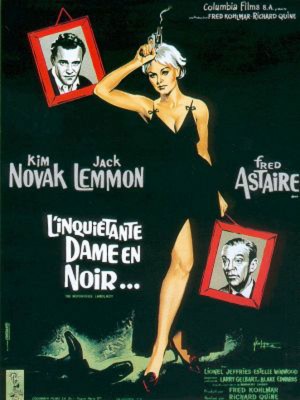
| 1962 | The disturbing lady in black | Franklyn Ambruster | 2.9 |
| 1961 | My father seducer | Biddeford 'Pogo' Poole | 3.4 |
| 1959 | The Last Shore | Julian Osborne | 3.4 |
| 1957 | Funny face | Dick avery | 3.8 |
| 1957 | The Beauty of Moscow | Steve canfield | 3.5 |
| 1955 | Daddy long legs | Jervis Pendleton III / John Smith | 3.5 |
| 1953 | All on stage! | Tony hunter | 3.8 |
| 1952 | New York Beauty | Charlie hill | 3.0 |
| 1950 | Let's dance | Donald elwood | 3.0 |
| 1950 | Royal wedding | Tom bowen | 3.6 |
| 1950 | Three Little Words | Bert Kalmar | 3.0 |
| 1949 | Let's get into the dance | Josh barkley | 3.6 |
| 1948 | Spring parade | Don Hewes | 3.6 |
| 1946 | Blue skies | Jed potter | 3.1 |
| 1946 | Ziegfeld Follies | Himself / Raffles / Tai Long / A gentleman | 3.3 |
| 1945 | Yolanda and the thief | Johnny Parkson Riggs | 3.0 |
| 1943 | The unforgettable adventure | Fred Atwell / Fred Burton | 2.9 |
| 1942 | Love sings and dances | Ted hanover | 3.2 |
| 1942 | O you my lovely | Robert davis | 3.6 |
| 1941 | Love comes dancing | Robert curtis | 3.1 |
| 1940 | Broadway dancing | Johnny brett | 3.0 |
| 1940 | Swing romance | Danny O'Neill | 2.9 |
| 1939 | The Great Farandole | Vernon Castle | 2.9 |
| 1938 | Amanda | Tony flagg | 3.3 |
| 1937 | Damsel in distress | Jerry halliday | 2.9 |
| 1937 | Enterprising Mr. Petrov | Pete R. Peters, aka Petrov | 3.4 |
| 1936 | Following the fleet | Bake baker | 3.2 |
| 1936 | On the wings of dance | John "Lucky" Garnett | 3.7 |
| 1935 | The Dancer from above | Jerry Travers | 4.0 |
| 1935 | Roberta | Huckleberry Haines | 2.9 |
| 1934 | The Happy Divorced | Guy holden | 3.5 |
| 1933 | Carioca | Fred ayres | 2.6 |
| 1933 | The dance whirlwind | Himself | 3.0 |